Product designers have always worked one step away from the real product. For most of the discipline’s history, our tools were built to describe software rather than run it, and they have done that job remarkably well.
Specs, mockups and prototypes carry a huge amount of intent from design to engineering. What they can’t fully show is how a design behaves once it’s real: how an empty state feels, where a long label breaks a layout, what someone sees when they don’t have permission to do what they came to do.
The industry has done serious work to narrow that gap. Design systems, shared tokens, component libraries and increasingly capable prototyping tools have brought design and engineering much closer, and made handoff far more precise. Even so, a meaningful share of what we learn about a design still arrives after it’s built, when changes cost the most.
AI tools build on that progress in a new way. A designer can now take an idea to a working version in code within hours, try directions that were once too costly to explore, and put something real in front of users and engineers much earlier. Used with care, they move more of that learning into the design process itself.
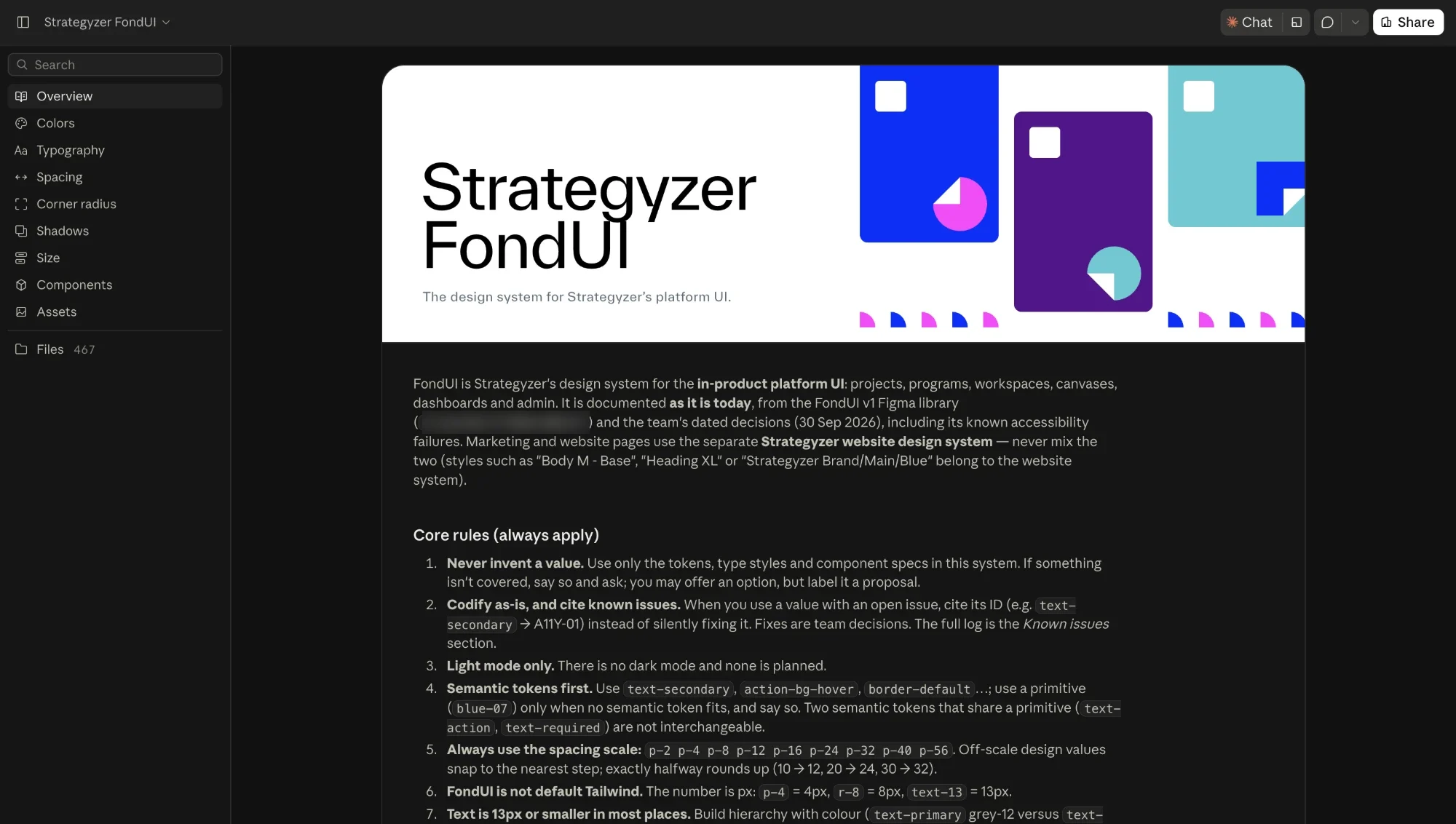
At Strategyzer, I saw that as a chance to change how our product team discovers and builds, and I took the lead on making it happen. I started with the foundation, rebuilding FondUI, our product design system, as a Claude skill so anything generated in code would look and behave like our product from the first screen. Then I reworked our process around it.
Discovery at Strategyzer now happens in working code. We test ideas as real flows, settle on a direction faster and find edge cases before development starts, and our engineers carry parts of that code directly into the platform. What follows is how I built it and what it has changed for the team.
What the gap cost a small team
I’m the only designer at Strategyzer, working alongside two developers and a head of product. On a team that size, every design decision carries a cost that’s easy to underestimate. Comparing two approaches to a flow meant designing both in detail, wiring them into clickable prototypes and walking the team through them, then waiting for engineering time before anyone saw how either one behaved with real data and real states.
That shaped how much we could explore. Good alternatives were sometimes set aside because they were expensive to validate. Edge cases tended to surface during development, when changing course took the most effort. And while clickable prototypes served our research well, people engage differently with a simulation of software than with software they can actually use.
- Design one or two directions in Figma
- Wire them into clickable prototypes
- Walk the team through them
- Wait for engineering time
- See it with real data and states
Edge cases show up here
- Describe the flow to Claude
- A working version, built with FondUI
Edge cases show up here - Compare several directions side by side
- Test with people on the real thing
- Engineers carry the code into the platform
None of this was a tooling failure, and Figma remains central to how I think and work. The opportunity was to shorten the distance between an idea and a working version of it, so more of the learning could happen while decisions were still cheap to change.
Teaching Claude our design system
AI tools can already generate interfaces, but not your interface. Ask for a settings page and you get something plausible and generic, with the wrong spacing, the wrong type scale and components your product doesn’t have. That’s fine for a quick sketch. It won’t hold up in real product discovery, and engineering can’t build on it.
So the foundation had to be FondUI, our product design system. Using Figma’s MCP tooling, I extracted its foundations and components from our Figma library and rebuilt them as a self-contained Claude skill, a package of instructions and assets Claude loads whenever it builds UI for Strategyzer. FondUI already lived in Figma, which made this much easier. With the Figma MCP connected, I had Claude pull the tokens, variables and components straight from the library. Where it fell short, I corrected it, sometimes with SVGs or screenshots. I worked as Claude’s design lead: checking that every direction was right, every rule was clear, and every detail was there. It took a couple of days. It was tedious in places, and worth it.
The tokens were the straightforward part. Color, typography, spacing, radius and elevation sit in semantic hierarchies, exposed as kebab-case CSS custom properties. They match the variables engineering uses in the codebase. That mattered to me: what Claude designs with is exactly what we ship.
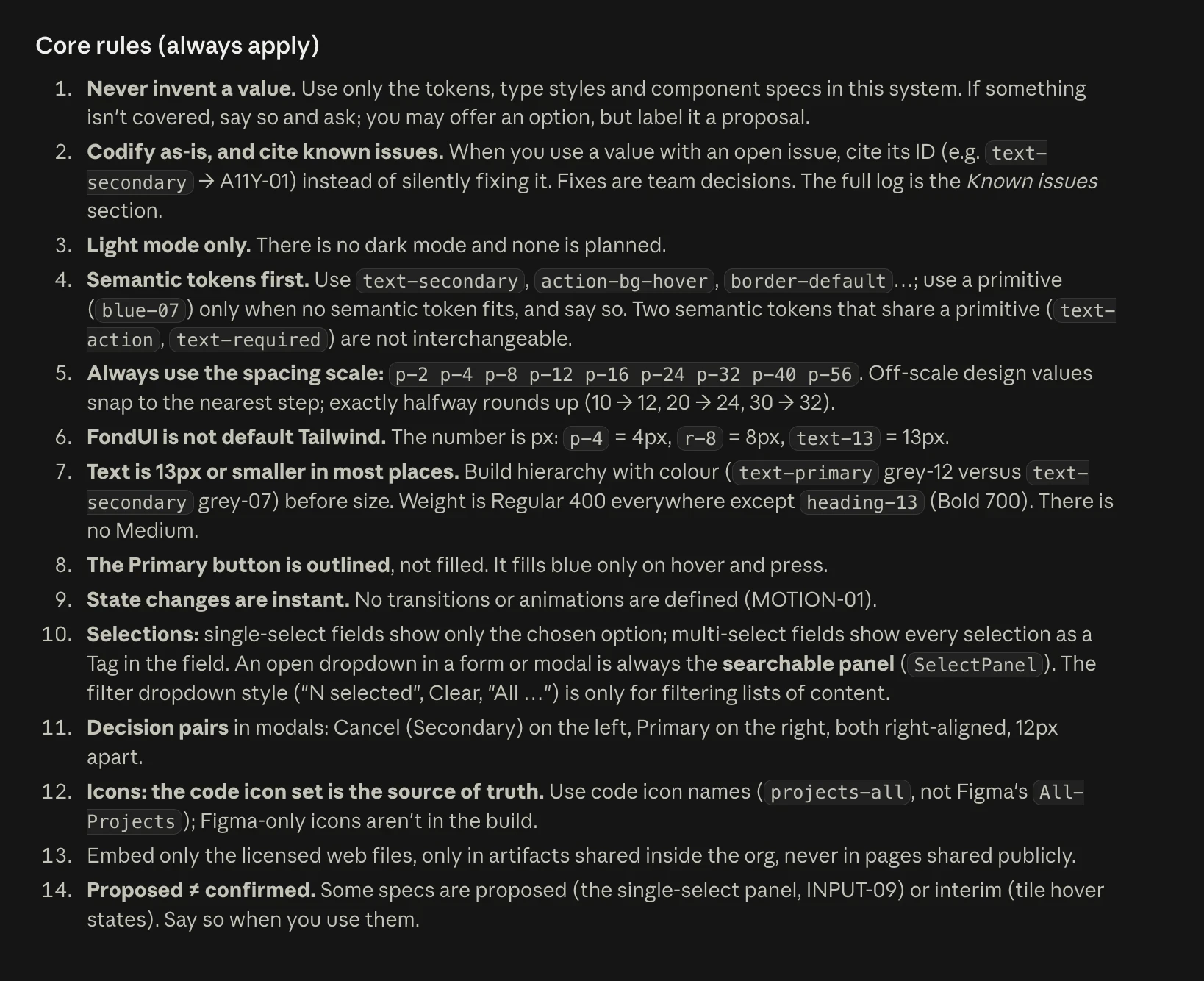
The rules were where the real design work lay. For every token, the skill says when to use it and when to avoid it. For every component, from buttons and the side navigation to inputs, toggles, radios and checkboxes, it says when to reach for it, when another component fits better, and how it behaves in each state, from hover and focus through to disabled and selected. These are judgment calls I’d normally make on instinct or explain in a design review. Writing them down precisely is what makes Claude’s output look like it came from our own Figma file.
How I work now
Exploration has become cheap, and that has changed how I approach almost every problem. When I have an idea for a flow, I describe it to Claude, it builds a working version with FondUI, and I review it with the same scrutiny I’d give a developer’s build: tightening layouts, rewriting copy, checking every state. When a stakeholder asks what happens if a user does something unexpected, I can usually show them the same day.
The bigger shift is in how many ideas we get to test. Where I used to take one or two directions to high fidelity, I now build several and put them side by side as working flows. The team clicks through each one, sees where it struggles, and we settle on a direction with far more confidence and much less debate.
Decisions move faster too. Often I don’t start in Figma at all. I describe the problem and what I’m thinking to Claude, and have a working version in minutes. I record a short Loom, the team watches it and responds, and we have feedback the same day. Before, I designed everything, built a prototype, sent it and waited for feedback, round after round. Now we agree on a direction in hours.
This only works because I start with a deep understanding of the user and the problem. That is what lets me tell Claude exactly what I need. The speed comes from the system. The judgment still has to come from me.
Edge cases get the same treatment. A working prototype won’t let you skip them: the empty state has to render something, the error has to say something useful, and the user who changes their mind halfway through still has to land somewhere sensible. I meet those moments while I’m designing, when they’re cheapest to get right and when I can give them proper attention.
Strattie AI and the Playbook Recommender
Our AI work shows this most clearly. The full story is in the Strattie case study. Here’s the part about working in code. Customers were asking for AI, so I prototyped Strattie AI, an assistant across the whole platform, with Claude and FondUI in a matter of days. Using real software showed us two things a mockup would have hidden: the value sat in the questions a coach asks before recommending anything, and an open chat box didn’t suit people who couldn’t yet describe their problem.
So the prototype changed the plan. Alongside my research, it helped our CEO and Head of Product agree, on a single call, to ship a three-question Playbook Recommender first and bring the assistant later.
Code shaped the Recommender’s design too. I compared three panel shapes as working flows. I’d also built a tour-style version, and once it ran it felt like a one-time tour, so the small corner panel shipped instead.
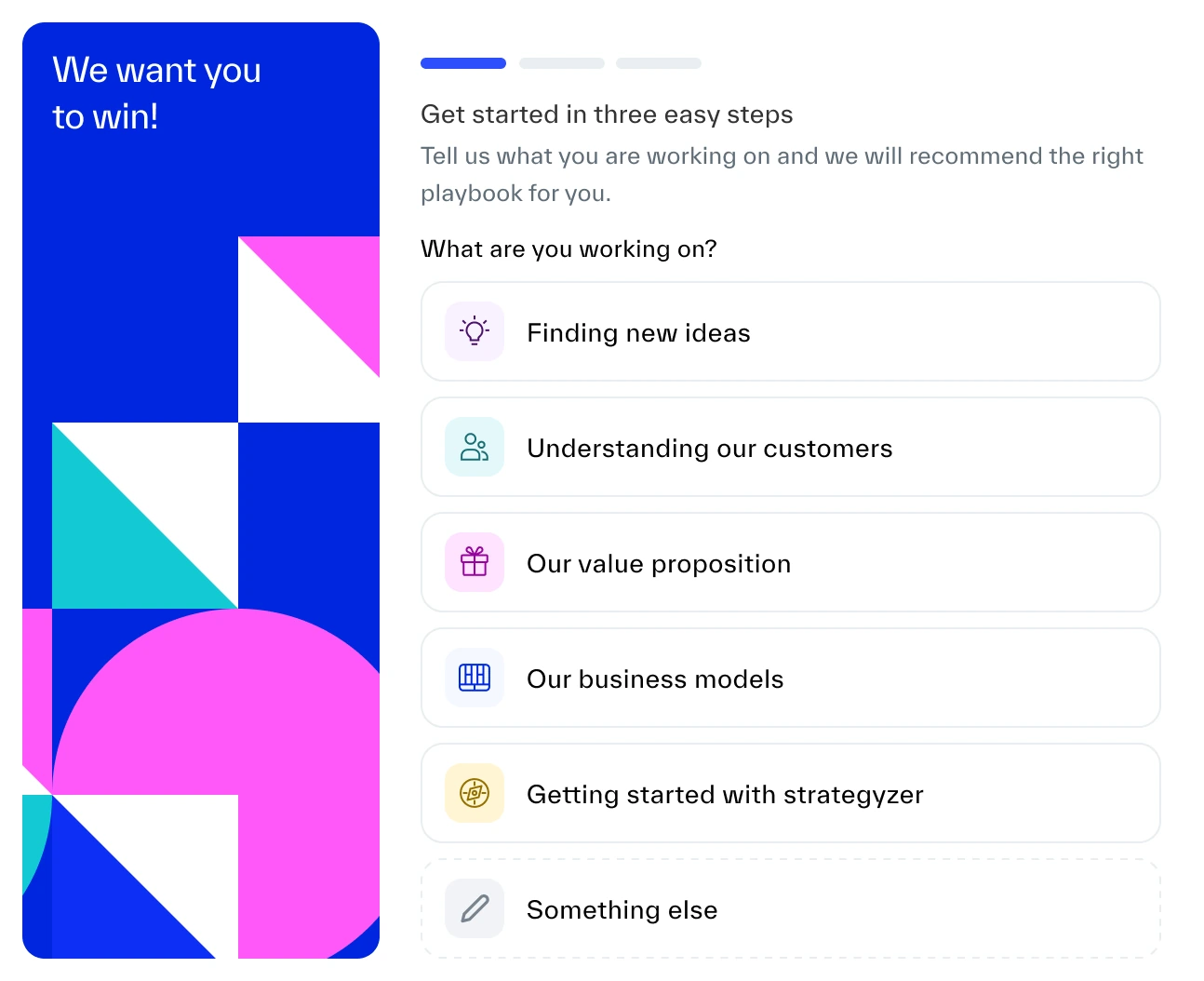
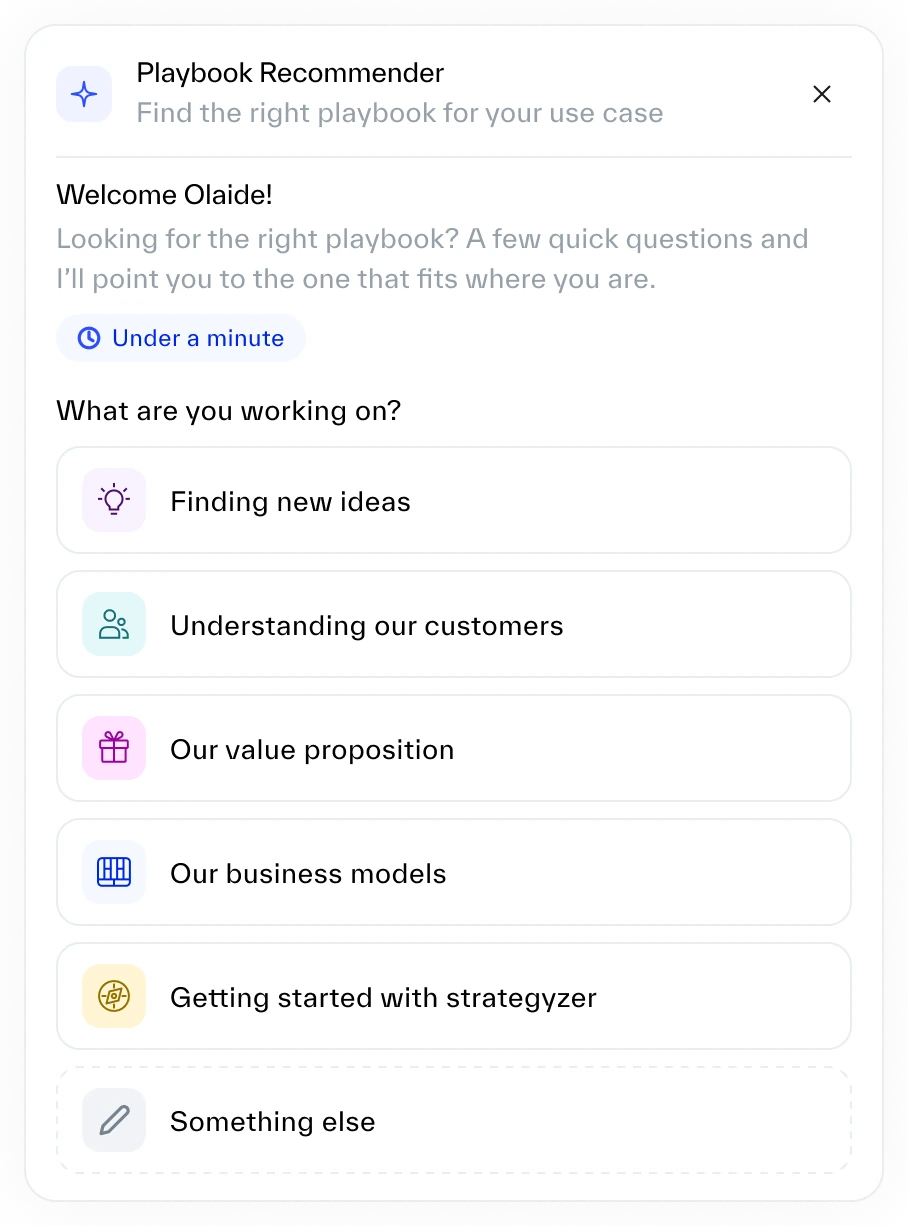
Tricky cases surfaced early, while they were cheap to fix, like a user changing an earlier answer, or no playbook matching what they need. The Recommender now says so honestly instead of guessing.
Code that engineering keeps
The largest impact has been on the engineering side, and it’s the one I underestimated at first.
Because the prototypes use the same tokens and components as the product, they aren’t throwaway work. Our engineers take parts of that code and use it directly in the platform. The Playbook Recommender is the clearest example: I built its front end with Claude, and that code went into the product unchanged. Our engineer wired it to the data and shipped it. Rather than rebuilding each screen from a design file, the team starts from code that already reflects the layout, spacing and state decisions we’ve made together.
That has changed how we work together. Handoff used to be a file and a walkthrough, followed by a round of questions. Now it’s often a working version we review side by side. With layout and states already settled, our conversations move sooner to architecture, data and performance, and the design carries through to production more faithfully.
From Ashley’s feedback, in my wordsThe biggest change is our velocity, especially on the engineering side.
Ashley Underwood, our Head of Product, oversees the team. He describes Claude as working almost like a junior designer: the front end I’ve already designed arrives built, and engineering connects it to the back end.
For a team our size, that changes how we use our people. We can do more without growing, and he sees the impact across the whole organisation.
Testing with something real
Research has improved in the same way. In interviews and validation sessions, participants use prototypes that behave like the product. They type, filter, change their answers and run into dead ends, and they respond to the experience itself, including moments a simulated flow can’t easily cover. Between sessions I can adjust the prototype, so each conversation tests a stronger version than the last.
For the Recommender, that meant about 24 sessions with coaches, customer teams and customers. Because people used the real thing, their feedback went straight into the design. The biggest change was to the questions, which I rewrote to be easier to answer without fear of choosing wrong.
The impact so far
Across the product team, the results show up in five places.
- More ideas tested
- Three panel shapes and two overall approaches, a tour and a tool, compared as working flows for the Recommender alone, where before I would take one or two directions to high fidelity.
- Faster decisions
- Direction agreed in hours. A working version takes minutes, a short Loom gets the team’s feedback the same day, and we no longer wait through rounds of designs and prototypes.
- Edge cases caught in design
- Changing an answer and finding no match, both resolved before development started.
- Code reused in production
- The Playbook Recommender’s front end went into the platform as built. The project took about six weeks from research to launch, and the team now works at least twice as fast.
- Stronger validation
- About 24 research sessions run on working prototypes for the Recommender.
What it doesn’t replace
None of this makes Figma or design judgment less important. I still explore visual direction in Figma, and the skill is only as good as the system and rules behind it. When FondUI evolves, the skill has to evolve with it, and keeping the two in step is now part of my job.
Claude doesn’t decide what’s worth building, either. It’s very good at producing a well-formed version of an idea. Deciding which ideas deserve to exist, and which trade-offs are right for our users, is still the core of the work. Code that reaches the platform goes through engineering review, as it should. What has changed is how strong the starting point is.
Where it led
FondUI was my first skill, and it changed how I think about what a design system is for. If a system could be encoded well enough for Claude to design our product with it, other teams could use the same approach for their own work. That idea grew into the marketing, sales and client delivery skills I wrote about in The Only Designer in the Room.
For our product team, the gap between an idea and a working version of it has almost closed. We test more ideas, choose between them with more confidence and reach development with fewer open questions. And I spend far less of my time describing what the product should do, and far more of it finding out.